
Before the Standing Wave
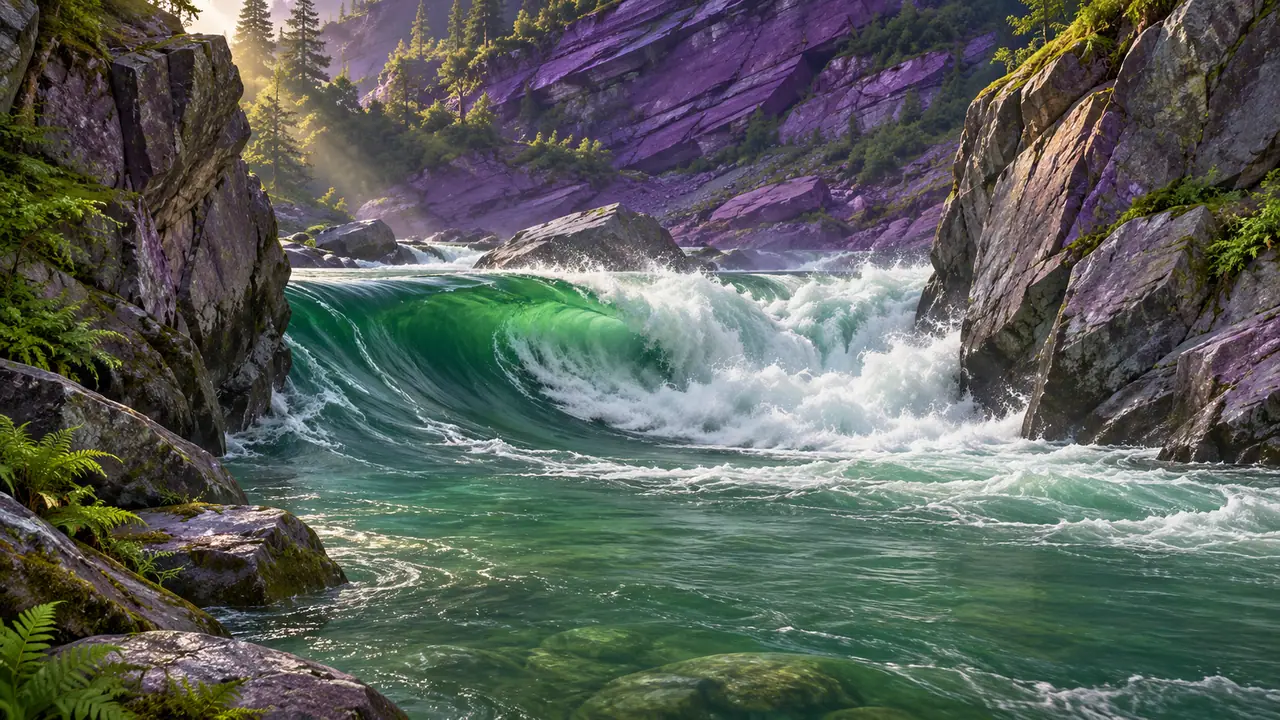
The longest approach in this fictional reach leads to a fixed wave between two unequal rock shelves. The brighter shelf sticks out farther into the water. The other remains mainly below the surface at the point where the wave forms. The guide has to decide which edge to approach before the wave has filled the center of the view. We use a small part of the upper channel to introduce that decision. A player can read some evidence far ahead, check what it means at a bend in the canyon, and preserve enough of it to choose a line when the time comes.
Read from the long approach
The game begins in relatively open water behind a tall reef of sandstone. You can point the raft far to the left and still look toward the main channel. A pale point in the dark rock at the edge of the river provides a reference. It stays visible while the larger line of foam moves between you and the wave. Try aligning the rim of the raft with the reference before steering out of the smooth water. At first the white line appears to meet the rock exactly. After a slight change in direction, it appears to continue beyond that point. You can then see where the wave’s shoulder is positioned in relation to the stone below it. The player does not need to remember the entire shape of the line.
Keep an angle you can judge
The view from the right wall presents the wave’s near end at a shallow angle. Several patches of foam pass through that end and move down the channel. The near crest does not move with them. You may compare the two while the raft drifts in a straight section toward a broad point of light in the wall. Give yourself one modest stroke to travel across the current and compare the resulting distance to the bright rock. The rock should become closer or farther away in the same way the guide predicted. If the foam appears to rotate in the opposite direction afterward, check the position of the raft. A change in view can be part of the reason you thought the crest was moving.
Preserve enough space for the next move
Try a second approach from the quiet strip just to the left. A change in current makes the approach feel narrower at this angle, although the pale part of the wave takes up less room on the screen. You may be able to hold a better line by using a guide point farther away. The game gives you enough water upstream to compare two small changes before the wave itself dominates the view. At the bottom of the approach, a short shoulder runs to an opening beside the left wall. It can provide another route when the first line has drifted too far. A run should remain readable when the player has made a partial correction on the way in.
A short approach prototype
The design is a canyon game concept, limited to the part of the run from quiet water to the wave. We aim to tell whether a player can predict which visible edge remains fixed as the raft moves. Reading the Wave at an Angle describes a test that changes the angle of view. The Widest Part of the Bend explains why an earlier sightline can affect the decision nearer the crest. These notes and the illustrations describe an imagined level. We use the controlled shape of the reach to isolate the clues the game needs.